LoRA Fine-Tuning Crashed on Three MoE Models in mlx-lm. The Fix Was One Line, Three Times.
— ai, local-llms, open-source — 4 min read
Fine-tuning a mixture-of-experts model with mlx_lm.lora --train on Apple
Silicon currently crashes for three model families — granitemoe,
granitemoehybrid, and lfm2_moe — with a VJP error on the router's integer
expert indices. I hit it mid-training, traced it to a one-line fix that
every other MoE model in the repo already had, and upstreamed it as
mlx-lm PR #1795, merged
today.
This isn't a deep investigation like the last piece I wrote about a PR — it's the other kind of contribution: small, mechanical, and almost entirely about noticing that a fix which already existed elsewhere in the codebase hadn't been applied everywhere it needed to be.
What broke
I was surveying MoE trainability on an M5 Pro, running LoRA fine-tunes
against Qwen3-30B-A3B and a few other mixture-of-experts checkpoints to see
what worked out of the box. Training on granitemoe crashed immediately on
the first backward pass:
ValueError: [gather_axis] Cannot calculate VJP with respect to indices. Use
stop_gradient on indices to stop gradients from being computed.
Same error, same shape, on granitemoehybrid and lfm2_moe. Forward
inference worked fine on all three — this only shows up once you ask MLX for
gradients.
Why it happens
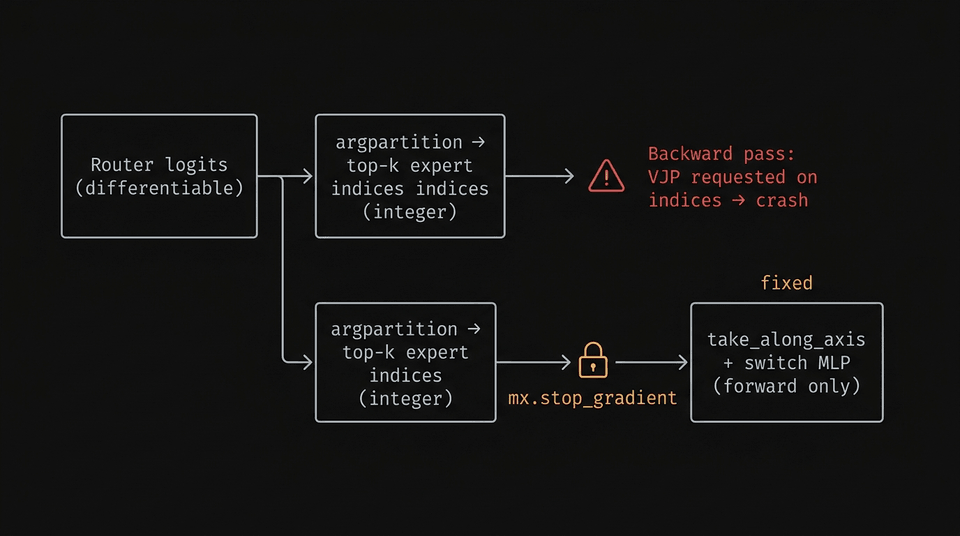
Every MoE layer in mlx_lm does roughly the same thing: run the input
through a router to get per-expert logits, pick the top-k experts, and gather
those experts' outputs. The router logits are differentiable — that's the
point, the router is a learned linear layer. But the indices you get from
picking the top-k are integers, produced by mx.argpartition, and MLX can't
compute a vector-Jacobian product through an integer index into gather_axis
/ take_along_axis. You have to explicitly tell autograd "stop here, these
are not differentiable":
top_k_idx = mx.stop_gradient(
    mx.argpartition(logits, kth=-self.top_k, axis=-1)[..., -self.top_k :]
)
Without that barrier, calling .backward() (which mlx_lm.lora --train
does on every step) asks for a gradient with respect to the indices
themselves, and MLX correctly refuses.
The part that made this an easy fix
This wasn't a novel bug. A quick survey of mlx_lm/models/ showed that most
sibling MoE implementations — olmoe, mixtral, qwen2_moe, phimoe,
glm4_moe, bailing_moe, ernie4_5_moe, exaone_moe, afmoe, and others —
already wrap their routing indices in mx.stop_gradient. And a few days
earlier, PR #1787 had
landed the identical fix for qwen3_moe. Between the existing pattern and
that precedent, granitemoe, granitemoehybrid, and lfm2_moe were simply
the last three index-selecting MoE models in the repo missing the guard.
The fix per file:
granitemoe.py/granitemoehybrid.py— wrap theargpartitionslice inmx.stop_gradient(...), same shape as the existing fixed models.lfm2_moe.py— one added line,inds = mx.stop_gradient(inds), right after the indices are computed.
88 additions, 6 deletions, almost all of it test code.
Testing it properly
A one-line diff is easy to get wrong in a way that looks right — forward
pass unaffected, no visible symptom until someone runs --train. So the PR
adds a real regression test per model: build a tiny config (16 hidden size, 4
experts, 1–2 layers, no downloaded weights), run one forward and backward
pass, assert it doesn't raise. All three failed 3/3 before the fix and passed
3/3 after.
The first review comment from the mlx-lm maintainer wasn't about the fix
itself — it was about test placement: move the tests into
tests/test_tuner_trainer.py to match the structure #1787 had already
established, instead of a new standalone file. Small ask, straightforward
to match:
def test_granitemoe_backward(self):
    from mlx_lm.models import granitemoe
    model = granitemoe.Model(granitemoe.ModelArgs(...))
    self._assert_backward(model)
Repeated for the other two families, using each model's actual config shape
(lfm2_moe needed layer_types=["conv", "full_attention"] and
conv_L_cache to build at all). Full test_tuner_trainer.py passed locally
— 5 tests, all green — before the second push.
Why this is worth writing up at all
There's no dramatic verification story here, unlike reviewing ornith-9b's quecto PR, where the interesting part was catching a claim that didn't match the diff. This one is closer to the median useful open-source contribution: hit a real crash doing real work, recognize it as an instance of a pattern the maintainers had already solved twice, apply the same fix a third time with proper regression coverage, and get it merged same-week with one round of review feedback.
If you're running LoRA fine-tunes against MoE checkpoints on mlx-lm and
hit [gather_axis] Cannot calculate VJP with respect to indices on a model
family not listed above, this is almost certainly the same bug — check
whether that model's router wraps its top-k indices in mx.stop_gradient
before the gather.
Related: A Free Local 9B Model Optimized My Rust Agent Harness covers a different kind of contribution — verifying a locally-generated PR's claims against the diff rather than fixing a bug found by hand. The Batch Size That Breaks Local LLM Serving on Apple Silicon and the rest of the MLX benchmark series cover other Apple Silicon inference constraints found the same way this bug was: running real workloads until something breaks, then tracing why.