Distilling Ornith-1.5-9B: a 4.9 GB Model That Beats the 8.9 GB One It Replaces
— ai, local-llms, open-source — 16 min read
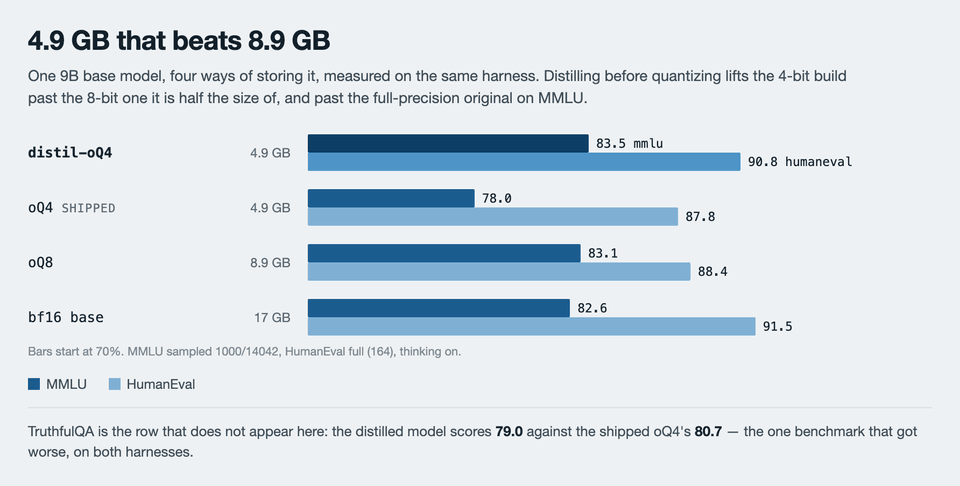
I spent about a week distilling a 9B reasoning model on one Mac, and the result is a 4.9 GB checkpoint that outscores the 8.9 GB build of the same model and matches the 17 GB full-precision original on MMLU.
Model →
adityak74/Ornith-1.5-9B-MLX-distil-oQ4on Hugging Face, or on Ollama:ollama run adityakarnam/Ornith-1.5-9B-MLX-distil-oQ4. 4.9 GB, runs on any Apple Silicon Mac with ~8 GB free. 83.5 MMLU · 79.0 TruthfulQA · 90.8 HumanEval. Full pipeline and decisions log:adityak74/ornith-1.5-9b-distil.
The headline is nice. The interesting part is that it happened for a reason I did not predict, and that reason is probably useful to anyone shipping a quantized reasoning model.
Why bother
Ornith-1.5-9B ships in a few precisions, and I had measured all of them on
my own harness before starting. The 4-bit build — oQ4, a mixed-bit scheme,
4.9 GB — is the one you actually run on a laptop. It is also the one that
loses the most:
| Model | MMLU | TruthfulQA | HumanEval | size |
|---|---|---|---|---|
| Ornith-1.5-9B bf16 | 82.6 | 80.5 | 91.5 | 17 GB |
| Ornith-1.5-9B oQ8 | 83.1 | 80.7 | 88.4 | 8.9 GB |
| Ornith-1.5-9B oQ4 | 78.0 | 80.7 | 87.8 | 4.9 GB |
| Ornith-1.5-9B oQ3 | 66.6 | 67.6 | 72.0 | — |
| Qwen3.6-35B-A3B-4bit | 89.3 | 89.2 | 93.3 | 19 GB |
| Ornith-1.5-35B-A3B-4bit | 83.0 | 86.4 | 93.3 | 19 GB |
bf16 → oQ4 costs 4.6 points of MMLU and 3.7 of HumanEval. That gap is a quantization problem, not a knowledge problem: the 9B demonstrably has the capability at full precision and loses it in the 4-bit map. So the plan was never "make the model smarter." It was: teach the bf16 student from teachers that are genuinely better, fuse, and only then quantize, so the quantizer starts from an improved checkpoint instead of compounding two lossy steps.
Two teachers, split by what each is measurably good at
The two 35B MoE models in that table are not ranked, they are complementary, and it matters:
- Qwen3.6-35B-A3B-4bit is +6.3 MMLU and +2.8 TruthfulQA over the other teacher. It teaches knowledge and truthfulness.
- Ornith-1.5-35B-A3B-4bit ties Qwen exactly on HumanEval (153/164 each) and gets there 4.6× faster — 2.6 hours to run the full benchmark suite against Qwen's 6.1. So it teaches code and does the bulk of the generation work, because it is cheap.
Both are 3B-active MoEs, which is why they are faster than the dense 9B student they are teaching despite being four times its parameter count.
Picking teachers per domain rather than picking "the best model" is the cheapest decision in the whole project and probably the highest leverage one.
The pipeline
Eight stages, every one resumable — re-running skips ids already on disk, which matters when a stage is a ten-hour generation job and your Mac has other opinions about what it wants to do tonight.
odistil prompts     # build the prompt pool from HF datasets
odistil teach       # generate teacher traces (batched MLX generation)
odistil dataset     # verify, decontaminate, mix
odistil train       # rank-32 LoRA over the bf16 student
odistil fuse        # fuse adapters back to bf16
odistil quantize --variant oq4
odistil eval --model runs/v1/quant/oq4
odistil report --time
Stage 3 is where the quality comes from, and it is not subtle. A teacher trace is kept only if its answer is verifiably correct:
- multiple choice → the teacher's letter must match the gold letter
- open QA → normalized match against the gold aliases
- code → the generated program is executed against its source dataset's own unit tests in a sandboxed subprocess
Then anything sharing a 13-gram with MMLU test, TruthfulQA or HumanEval is dropped before training. 3,974 traces were generated; 1,672 survived. That 58% rejection rate is the product.
What the hardware decided
A 9B in bf16 is ~18 GB of weights; AdamW adds ~72 GB of fp32 optimizer state. That does not fit in 64 GB, so a full fine-tune was never on the table. LoRA over the full-precision base was.
What surprised me was where the memory actually goes. Measured peak, batch 1, gradient checkpointing on:
| sequence length | layers adapted | peak memory | speed |
|---|---|---|---|
| 1024 | 32 (all) | 48.6 GB | 36 s/iter |
| 1024 | 16 | 47.8 GB | 20 s/iter |
| 1024 | 8 | 47.4 GB | 14 s/iter |
| 512 | 8 | 27.2 GB | 7 s/iter |
Adapting a quarter of the stack instead of all of it saves 1.2 GB and 61% of
the time. Memory is driven by the forward pass, not by how many layers carry
adapters — roughly 20 MB per token, because this architecture's hybrid
linear_attn layers materialise per-timestep state. The layer count only
truncates backprop, so it buys speed, not footprint. Sequence length is the
only real lever on memory.
Settled on rank 32 over the top 16 of 32 layers, 1024-token sequences, batch 1. 3,200 steps, 1.76M tokens, one M4 Pro.
Two more things the machine dictated. Gradient accumulation of 4 kept four
backward graphs alive and hit Metal's 499,000 live-resource limit, so the
effective batch is 1 and the learning rate came down to match. And GPU stages
have to run strictly one at a time — running Qwen generation alongside a
training job killed both with [METAL] Command buffer execution failed: Insufficient Memory, because a 4-bit 35B teacher is ~19 GB and the training
job peaks near 48 GB against a 52 GB recommended working set.
The 1024-token cap cost half the data, and I paid it anyway
Training targets include the teacher's full reasoning trace. At a 1024-token cap, that means dropping every sample whose prompt plus reasoning exceeds it:
| cap | kept, with reasoning | kept, answer only |
|---|---|---|
| 896 | 43% | 98% |
| 1024 | 50% | 99% |
| 1280 | 62% | 100% |
Stripping the reasoning would have kept essentially every sample. I did not,
because the chat template pre-opens a <think> block: a student trained on
answer-only targets learns to emit </think> immediately and stop reasoning —
exactly the behaviour it is evaluated and served with. Half the data with
intact reasoning beats all of it with the reasoning removed.
The fix that does not trade away the behaviour is to make the teacher brief. The knowledge teacher is asked to keep reasoning under 150 words, and rejection sampling still throws out any answer that got worse for the brevity — so the risk is a lower keep rate, not a worse student.
Measuring the baseline found bugs in my own harness
Before distilling anything I ran the undistilled bf16 student through my harness. It scored 82.3% HumanEval where the reference numbers said 91.5%. Of the 29 failures, 22 were the harness, not the model:
- 20 truncations. Items hit a 2048-token cap mid-reasoning and scored wrong. Failures averaged 1,821 generated tokens against 708 for successes. Fix: per-benchmark budgets (HumanEval 4096, MMLU 3072), and the truncation count reported next to every accuracy, so a low score that is really a budget problem announces itself.
- 3
NameErrors. The model returns just the function, dropping the imports and helpers the HumanEval prompt supplies. Fix: prepend the problem prompt as a preamble before the extracted code.
Rescoring the existing outputs with the preamble fix alone moved 132/160 to 135/160. If you are evaluating a reasoning model and not reporting truncations, some fraction of your accuracy number is measuring your token budget.
Corrected baseline: 145/164 = 88.4% HumanEval for the bf16 base on my harness. That is the number the distilled model had to beat — not the 91.5% from a harness whose prompt formatting, parsing and budget handling I cannot see.
One measurement that saved five GPU-hours
The original code pool was 384 MBPP problems plus 1,500 CodeFeedback instructions. After generating 512 traces I checked the keep rate instead of assuming it:
| source | traces | usable | verified how |
|---|---|---|---|
| MBPP | 384 | 74% | executed against the real tests |
| CodeFeedback | 128 | 24% | syntax only — 53% truncated away |
CodeFeedback is free-form instruction data. Its answers are long, they run past the generation budget, and there is nothing to verify them against. Three quarters of the compute spent on it produced nothing usable.
Dropped it, and replaced the volume with the rest of MBPP — my code benchmark is HumanEval, so MBPP's test and validation splits are training data, not eval data. That took the code slice from 384 verified plus 1,500 unverifiable prompts to 974 prompts that all ship with executable tests, for less total generation time.
The first result looked like a failure
| model | HumanEval | truncated |
|---|---|---|
| bf16 base (undistilled) | 88.4% | 15 |
| distilled oQ4 | 84.1% | 19 |
Four points down. I wrote it up as a negative result, noted that eight of the 14 problems lost were truncations, and started drafting the v2 changes.
Then I noticed the comparison was wrong. I was comparing a 4.72-bit model against a bf16 one, which folds the entire cost of quantization into what was supposed to be the distillation delta. The like-for-like comparison — both models quantized with the same oQ4 map, both measured by the same harness — is a different picture:
| benchmark | shipped oQ4 | distilled oQ4 | delta | truncations |
|---|---|---|---|---|
| MMLU (n=250) | 81.2% | 82.4% | +1.2pp | 24 → 10 |
| TruthfulQA (250) | 72.4% | 70.8% | −1.6pp | 27 → 20 |
| HumanEval (164) | 72.0% | 84.1% | +12.2pp | 39 → 19 |
Same distilled checkpoint, same score, opposite conclusion. The lesson is boring and I will be repeating it to myself for a while: a distillation delta and a quantization delta are two different measurements, and if your baseline is not at the same bit width you are measuring both at once.
What it actually fixed: termination, not knowledge
Look at the truncation column above. It roughly halves in every row.
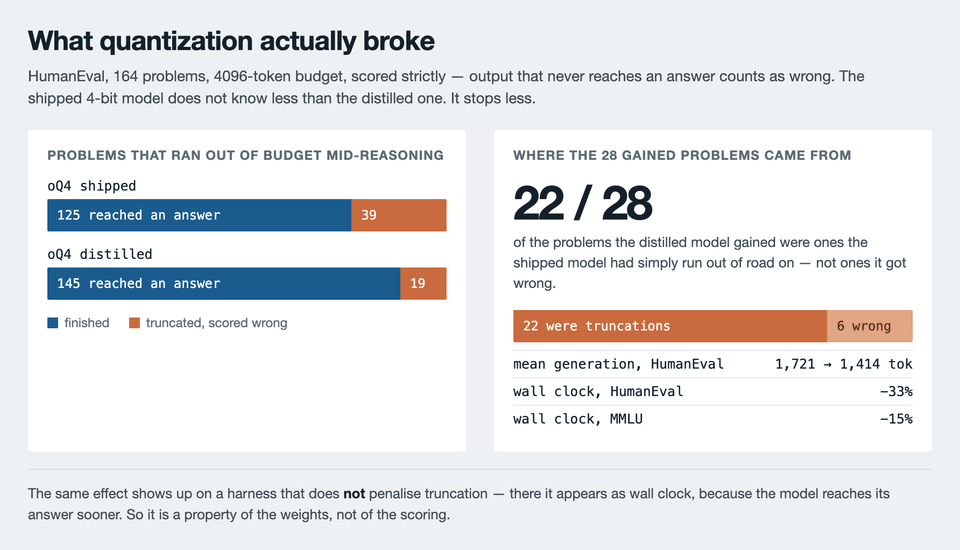
Against the shipped oQ4, the distilled model gained 28 HumanEval problems and lost 8 — and 22 of the 28 gains were problems where the shipped model simply ran out of budget mid-reasoning. It never reaches an answer on 24% of HumanEval. The distilled model cuts that to 12%, and mean generation drops from 1,721 tokens to 1,414.
So the working hypothesis: quantization damages a model's ability to stop reasoning more than its ability to reason. Training on teacher traces that terminate cleanly repairs much of that.
It also explains the flat multiple-choice results, which had been bothering me given that 75% of the training data went to knowledge and truthfulness. A truncated multiple-choice answer is often still recoverable from context. A truncated program never is. There is simply less broken behaviour available to repair on MMLU, so there is less to gain.
Two harnesses, and why the smaller number is the true one
I re-measured the distilled model on the serving harness that produced the original table — the one that matters for deployment, and that does not penalise truncation the way mine does:
| benchmark | my harness | serving harness |
|---|---|---|
| MMLU | +1.2pp | +5.5pp |
| TruthfulQA | −1.6pp | −1.7pp |
| HumanEval | +12.2pp | +3.0pp |
TruthfulQA agrees to within 0.1pp. MMLU differs because I only measured 250 items there (±6.9pp at that size — the delta was never resolvable). HumanEval differs by nine points, and the reason is worth stating plainly: the two harnesses disagree about the shipped model, not the distilled one. Mine scores shipped oQ4 at 72.0% where the serving harness scores it 87.8%, because the serving harness recovers an answer from output I score as unfinished.
+3.0pp is the number to trust. My +12.2pp was inflated by measuring a failure mode the other harness masks. I would rather publish the smaller number with the reason attached than the bigger one.
The effect is real on both, though, and the independent confirmation is the clock: against the shipped oQ4 on the serving harness, the distilled model is 33% faster on HumanEval and 15% faster on MMLU. It reaches its answer sooner, on a harness that does not care about truncation at all. That is a property of the weights, not of the scoring.
The benchmark that got worse
TruthfulQA regressed 1.7 points, consistently, on both harnesses. That is a real regression and it belongs in the headline, not a footnote.
The cause is almost certainly the training data. The truthfulness slice was 626 samples drawn from TriviaQA and SciQ — datasets that reward confident factual recall. TruthfulQA measures close to the opposite reflex: resisting a plausible-sounding falsehood and declining to assert. I trained the model to be more confident and then measured it on a benchmark that punishes exactly that.
If truthfulness is what you care about, use the stock oQ4 or oQ8. This is a
known defect with a known fix, not a mystery — which is the useful kind of
failure.
Using it
The shortest path is Ollama:
ollama run adityakarnam/Ornith-1.5-9B-MLX-distil-oQ4
Or straight from MLX:
pip install mlx-lm
mlx_lm.generate --model adityak74/Ornith-1.5-9B-MLX-distil-oQ4 \
  --prompt "Explain the difference between a process and a thread." \
  --max-tokens 1024
from mlx_lm import load, generate

model, tokenizer = load("adityak74/Ornith-1.5-9B-MLX-distil-oQ4")
prompt = tokenizer.apply_chat_template(
    [{"role": "user", "content": "Write a function to check if a string is a palindrome."}],
    add_generation_prompt=True,
    tokenize=False,
)
print(generate(model, tokenizer, prompt=prompt, max_tokens=4096))
It is a reasoning model and the chat template opens a <think> block for it,
so give it room: 4096 max tokens for coding problems, 2048+ for everything
else. Truncating mid-reasoning throws away the answer entirely — which, if you
have read this far, you will recognise as the entire subject of this post.
Runs on any Apple Silicon Mac with ~8 GB free. Note that it is slower than the 35B MoE teachers on the same machine despite being a quarter their size, because it is dense and they activate ~3B parameters per token. It wins on memory, not latency.
What v2 changes
v1 shipped at 83.5 / 79.0 / 90.8. Two defects were diagnosable from v1's own data, so v2 fixes exactly those and holds everything else constant — same teachers, same rank-32 LoRA, same 1024-token cap, same quantization map. If v2 moves, the cause is identifiable.
- The truthfulness slice taught the wrong reflex. TriviaQA and SciQ are replaced with a misconception true/false set: 1,703 statements, 63% of them misconceptions, with gold labels so traces stay verifiable, and zero 8-gram overlap with TruthfulQA. SciQ moves to the knowledge slice where it always belonged.
- The code teacher was never asked to be brief. The knowledge teacher was; the code teacher was not, and v1 lost 356 code traces to the length cap — more than it lost to wrong answers (93). Regenerating that slice with a brevity instruction costs about two GPU-hours and should return several hundred extra verified samples to the slice that had the fewest.
The bigger change I keep circling is real logit distillation. All three models
share an identical 248,044-token vocabulary — the two Ornith tokenizer.json
files are byte-identical, Qwen's differs only in formatting — so KL against
teacher logits is genuinely available. The right shape is offline: record the
teacher's top-64 logprobs per generated token during the generation stage, then
train on a mix of cross-entropy and KL against those sparse targets. Online KD
would need a 19 GB teacher and an 18 GB student co-resident with optimizer
state, which does not fit. Offline costs disk and nothing else.
A change worth making, reverted for a boring reason
Prompt sampling uses rng.sample(range(N), n), which is stable when other
pools get resized but not when this one does. Growing the MMLU pool
reshuffles the selection, and every trace already generated stops matching by
id. Taking a prefix of one fixed shuffle fixes that properly, so I made the
change — and then measured what it cost: reusable v1 traces dropped from 2,400
to 65. Switching methods invalidates every trace generated under the old
one, and 2,400 traces is about five GPU-hours.
Reverted, with the reasoning left in the code. It is the right design to adopt at the start of a run that has nothing to reuse, and the wrong one to adopt in the middle of a project.
Caveats
- Every delta here compares checkpoints measured by the same harness against each other. Cross-harness absolute numbers do not agree and are not meant to.
- MMLU and TruthfulQA in my own harness were measured on seeded 250-item subsets; deltas under ~7pp are not resolvable at that size. The full-protocol numbers in the headline table come from the serving harness.
- None of the original targets (86–89 MMLU / 86–89 TruthfulQA / 92–94 HumanEval) were reached. What was reached is a better model at the same size, which was the useful half of the goal.
- One base model, one architecture, one machine. The termination hypothesis is the thing I would most like someone else to test on a different model family.
- The base model card states no license, so the terms governing this derivative are whatever govern that model and its upstreams — including Gemma terms, which flow downstream. Check those before redistribution. This repo claims nothing beyond the recipe.
The transferable part
Three things I would carry to any project like this:
- Distill in full precision, quantize last. The quantizer then starts from an improved checkpoint instead of compounding two lossy steps, and you get to recover capability the 4-bit map was throwing away.
- Report truncations next to accuracy. For a reasoning model, a low score and a small token budget are indistinguishable without it — and the gap between two harnesses is usually right there.
- Measure keep rates before spending the GPU-hours. The single best decision in this project was generating 512 code traces, checking what fraction was usable, and throwing out a data source at 24%.
Repo: github.com/adityak74/ornith-1.5-9b-distil
— including DECISIONS.md,
which is the running log of every judgement call with the evidence behind it,
including the two above that I got wrong first.
Model: adityak74/Ornith-1.5-9B-MLX-distil-oQ4.
Built with mlx-lm on an M4 Pro.